
5 VSCode Extensions Every Developer Needs in 2025

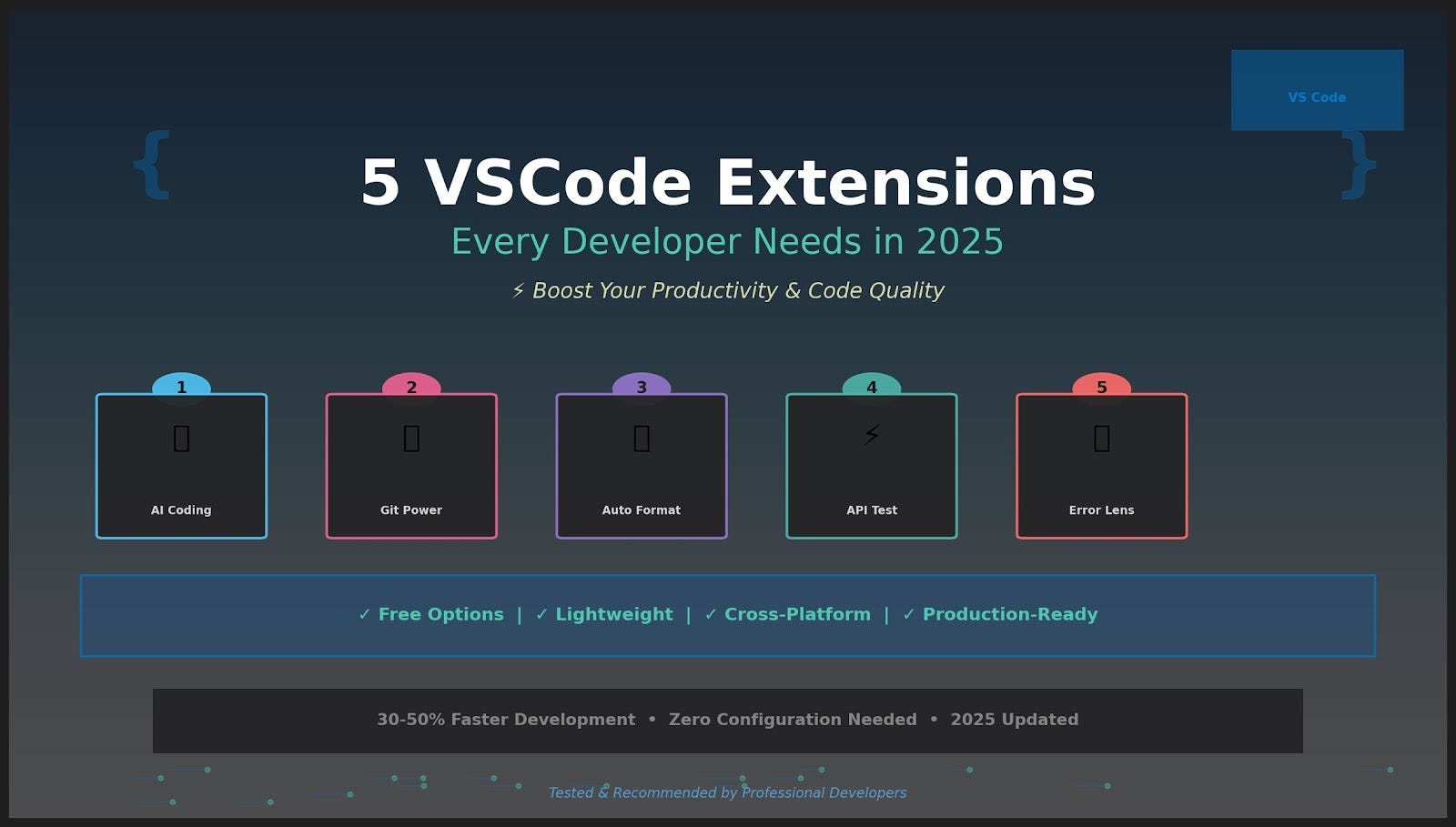
5 VSCode Extensions Every Developer Needs in 2025
Introduction: Supercharge Your Development Workflow
Visual Studio Code has dominated the developer landscape with over 30,000 extensions available in its marketplace, but here's the reality: most developers install too many extensions that slow down their IDE and clutter their workspace. The key isn't quantity—it's choosing the right tools that genuinely transform your productivity.
In 2025, the focus has shifted toward leaner setups, faster editors, and extensions that deliver real value rather than visual novelty. After analyzing current trends, developer feedback, and practical testing, we've identified five essential VSCode extensions that every developer—whether you're building web apps, APIs, or enterprise software—should have installed.
These aren't just popular extensions; they're productivity multipliers that address real pain points in modern development workflows.
Why These 5 Extensions Stand Out
Before diving into the list, here's what makes these extensions essential:
✅ Proven impact on developer productivity
✅ Active maintenance and regular updates in 2025
✅ Lightweight performance that won't slow your IDE
✅ Cross-language support for multiple tech stacks
✅ Free or freemium options available
Let's explore each extension in detail.
1. GitHub Copilot: Your AI Pair Programmer
What It Does
GitHub Copilot is an AI-powered coding assistant that integrates directly into VSCode, providing intelligent code suggestions, explanations, and even automated implementations as you type. Powered by OpenAI's advanced models and trained on billions of lines of code, Copilot has evolved into a comprehensive development companion.
Key Features (2025 Update)
Code Completion Intelligence:
Real-time code suggestions based on context and comments
Multi-line code generation from natural language descriptions
Function and class implementation from method signatures
Support for 20+ programming languages including Python, JavaScript, TypeScript, Go, Ruby, and more
Advanced Capabilities:
Chat Interface: Ask questions and get instant coding help without leaving your editor
Code Explanation: Highlight complex code to get AI-generated explanations
Bug Detection: Identifies potential issues and suggests fixes
Test Generation: Automatically creates unit tests for your functions
Refactoring Assistance: Suggests code improvements and optimizations
2025 Enhancements:
Access to multiple AI models including Claude Opus 4.1 and GPT-4 variants
Autonomous code refactoring capabilities
Improved multi-file context awareness
Pull request description generation
Why You Need It
Productivity Boost: Developers report 30-55% faster coding with Copilot, especially when writing boilerplate code, documentation, or working in unfamiliar languages.
Learning Accelerator: For junior developers, Copilot acts as a real-time mentor, demonstrating best practices and proper syntax as you code.
Context Switching Reduction: Instead of constantly searching Stack Overflow or documentation, get answers instantly within your editor.
Pricing & Plans
Copilot Free: Up to 2,000 inline suggestions and 50 premium requests per month
Copilot Pro: $10/month with unlimited suggestions and advanced features
Copilot Enterprise: Team collaboration features and custom models
Installation
1. Open VSCode Extensions (Ctrl+Shift+X)
2. Search "GitHub Copilot"
3. Install and sign in with your GitHub account
4. Start coding with AI assistance
💡 Pro Tip: Use comments to guide Copilot. Write // function to validate email addresses and watch it generate the complete implementation.
2. GitLens: Git Supercharged
What It Does
GitLens transforms VSCode's built-in Git capabilities into a powerful version control powerhouse, providing deep insights into code history, authorship, and collaboration . It's maintained by GitKraken and has become the de facto standard for Git visualization in VSCode.
Key Features
Blame Annotations:
Inline Blame: See who wrote each line of code and when, directly in your editor
Status Bar Blame: Quick commit information for the current line
File Annotations: Complete blame history for entire files
Hover Details: Detailed commit information on hover
Commit Graph & History:
Visual branch comparison showing commits ahead or behind
Interactive commit graph for repository visualization
File history with visual diff comparisons
Branch timeline and merge tracking
Advanced Git Operations:
Interactive Rebase Editor: Simplified interface for complex Git operations
Worktrees Management: Handle multiple working trees efficiently
Stash Management: Visual stash browser and application
Remote Repository Integration: GitHub, GitLab, Bitbucket support
AI-Powered Features (GitLens Pro):
Commit message generation
Code review assistance
Intelligent merge conflict resolution
Why You Need It
Code Archaeology Made Easy: Instantly understand why code was written, who wrote it, and what problem it solved—crucial for maintaining legacy code or onboarding new team members.
Collaboration Enhancement: See your team's contributions in real-time, track feature development across branches, and understand project evolution.
Debugging Context: When fixing bugs, quickly identify when problematic code was introduced and the surrounding changes that might be relevant.
Pricing
GitLens Free: Core features including blame, file history, and basic visualization
GitLens Pro: $9/month for commit graph, worktrees, and AI features
Installation
1. Open VSCode Extensions (Ctrl+Shift+X)
2. Search "GitLens"
3. Install and reload VSCode
4. Access via sidebar or inline annotations
💡 Pro Tip: Use Alt+B (Windows/Linux) or Option+B (Mac) to toggle blame annotations on/off quickly.
3. Prettier: Automatic Code Formatting
What It Does
Prettier is an opinionated code formatter that automatically formats your code according to consistent style rules, eliminating debates about code formatting forever. It supports JavaScript, TypeScript, CSS, HTML, JSON, Markdown, and 15+ other languages.
Key Features
Automatic Formatting:
Format on Save: Automatically formats code every time you save a file
Format on Paste: Cleans up copied code instantly
Multi-Language Support: Works across your entire tech stack
Pre-commit Hooks: Ensures all committed code is formatted
Consistency Benefits:
Enforces consistent indentation, spacing, and line wrapping
Standardizes quote styles (single vs. double)
Manages line length and code wrapping
Handles trailing commas and semicolons
Team Collaboration:
Eliminates formatting-related code review comments
Reduces merge conflicts caused by whitespace differences
Creates uniform codebase regardless of team size
Works with
.prettierrcconfiguration files for team standards
Why You Need It
End Formatting Debates: No more team arguments about tabs vs. spaces, semicolons, or bracket placement. Prettier makes these decisions for you.
Focus on Logic, Not Style: Stop wasting mental energy on formatting. Studies show developers spend up to 15% of their time manually formatting code—time better spent solving actual problems.
Cleaner Git Diffs: Consistent formatting means git diffs show actual code changes, not whitespace differences.
Reduced Code Review Friction: Pull requests focus on logic and architecture instead of style nitpicking.
Configuration Example
{
  "semi": true,
  "trailingComma": "es5",
  "singleQuote": true,
  "printWidth": 80,
  "tabWidth": 2
}
Installation & Setup
1. Open VSCode Extensions (Ctrl+Shift+X)
2. Search "Prettier - Code formatter"
3. Install the official extension
4. Enable "Format on Save" in settings:
   - File > Preferences > Settings
   - Search "format on save"
   - Check the box
5. Set Prettier as default formatter
💡 Pro Tip: Use Shift+Alt+F to manually format any file, or configure VSCode to format only selected code with Ctrl+K Ctrl+F.
4. Thunder Client: Lightweight API Testing
What It Does
Thunder Client is a Rest API client built directly into VSCode, eliminating the need for external tools like Postman or Insomnia. It provides a clean, fast interface for testing APIs without leaving your development environment.
Key Features
API Request Management:
Full HTTP Methods: GET, POST, PUT, DELETE, PATCH, and more
Collections: Organize requests into logical groups
Environment Variables: Switch between dev, staging, and production endpoints
Request History: Automatically saves all your API calls
Import/Export: Share collections with your team via JSON or Git
Advanced Testing:
GraphQL Support: Test GraphQL queries and mutations
Authentication: Built-in support for Bearer tokens, Basic Auth, OAuth 2.0
Request Scripting: Pre-request and test scripts for automation
Response Testing: Assertions and validation
Cookie Management: Automatic cookie handling for session-based APIs
Developer-Friendly:
Code Generation: Export requests as cURL, JavaScript, Python, etc.
Syntax Highlighting: Beautiful JSON/XML response formatting
Response Time Tracking: Monitor API performance
Lightweight: No Electron overhead, runs natively in VSCode
Why You Need It
Eliminate Context Switching: Stop alt-tabbing between your code editor and Postman. Test APIs directly in the environment where you write code.
Faster Development Workflow: Make API calls instantly while debugging, reducing the feedback loop from minutes to seconds.
Version Control Integration: Save API collections alongside your code in Git, ensuring everyone on the team has the latest endpoint configurations.
Resource Efficiency: Thunder Client uses significantly less memory than Electron-based API clients, keeping your system responsive.
Installation
1. Open VSCode Extensions (Ctrl+Shift+X)
2. Search "Thunder Client"
3. Install and access via sidebar icon (lightning bolt)
4. Create your first request
Alternative: REST Client
If you prefer a more minimalist, text-based approach, consider REST Client. It lets you write HTTP requests in .http files with syntax highlighting and execute them with a single click—perfect for version-controlling your API tests.
💡 Pro Tip: Use environment variables to switch between local development (http://localhost:3000) and production (https://api.production.com) with one click.
5. Error Lens: Inline Error Highlighting
What It Does
Error Lens revolutionizes error visibility by displaying diagnostic messages (errors, warnings, and info) directly inline with your code, rather than requiring you to hover or check the Problems panel. It brings errors to your immediate attention, making debugging significantly faster.
Key Features
Enhanced Error Visibility:
Inline Error Messages: See full error text directly next to the problematic code
Color-Coded Severity: Errors in red, warnings in yellow, info in blue
Multi-Line Support: Displays complex error messages completely
Gutter Icons: Visual indicators in the editor gutter
Customization Options:
Delay Settings: Control when messages appear
Message Formatting: Customize error message appearance
Language-Specific Rules: Different settings per programming language
Exclude Patterns: Hide specific error types or patterns
Integration:
Works with ESLint, TypeScript, Python, and all language servers
Integrates with Prettier, Stylelint, and other linters
Supports custom diagnostic providers
Real-time updates as you type
Why You Need It
Faster Bug Detection: Stop hovering over red squiggles or checking the problems panel. Errors are immediately visible as you write code, reducing debugging time by up to 40%.
Improved Code Quality: When errors are visible in your peripheral vision, you fix them immediately rather than accumulating technical debt.
Learning Accelerator: For developers learning new languages or frameworks, seeing full error messages inline speeds up the learning curve dramatically.
Reduced Cognitive Load: No need to remember to check the problems panel—errors demand your attention naturally.
Installation
1. Open VSCode Extensions (Ctrl+Shift+X)
2. Search "Error Lens"
3. Install and reload VSCode
4. Errors will appear inline automatically
Configuration Example
{
  "errorLens.enabledDiagnosticLevels": ["error", "warning"],
  "errorLens.fontSize": "12",
  "errorLens.delay": 500
}
💡 Pro Tip: If inline messages feel overwhelming, configure Error Lens to show only errors (not warnings) until you're comfortable with the workflow.
Bonus Mention: Code Spell Checker
While not in our top 5, Code Spell Checker deserves an honorable mention . It catches typos in variable names, comments, and documentation—preventing embarrassing spelling errors in production code and improving code readability.
Quick Install: Search "Code Spell Checker" in extensions and install. It works immediately across all files.
Setting Up Your Optimal VSCode Environment
Installation Order
Start with Prettier for immediate code formatting benefits
Add GitHub Copilot to enhance coding productivity
Install GitLens for better version control insights
Add Thunder Client for API development
Enable Error Lens for better error visibility
Performance Optimization Tips
Avoid Extension Overload: Studies show that having 30+ extensions can slow VSCode startup by 3-5 seconds. Stick to essential tools.
Disable Unused Extensions: Use Developer: Show Running Extensions command to identify resource-heavy extensions and disable those you don't actively use.
Use Extension Packs Wisely: Some extensions come bundled with dependencies you might not need—install selectively.
Monitor Performance: Run Developer: Startup Performance to see which extensions impact load time.
Measuring Your Productivity Gains
After installing these extensions, you should notice:
✅ 30-50% reduction in time spent on code formatting
✅ 20-40% faster API development and testing workflows
✅ Fewer context switches between tools (estimated 15-30 minutes saved daily)
✅ Faster debugging with inline error messages
✅ Better code quality through AI-assisted suggestions
Common Questions About VSCode Extensions
Q: Will these extensions slow down VSCode?
A: These five extensions are specifically chosen for their lightweight performance. GitHub Copilot has the highest resource usage but provides proportional value. Thunder Client and Error Lens are particularly lightweight alternatives to heavier tools.
Q: Are there free alternatives to GitHub Copilot?
A: Yes! GitHub Copilot offers a free tier with 2,000 suggestions per month. Alternatives include Tabnine (freemium), Cody by Sourcegraph (free tier), and IntelliCode (Microsoft's free AI tool).
Q: Can I use Prettier with my existing ESLint configuration?
A: Absolutely! Install eslint-config-prettier to make ESLint and Prettier work together seamlessly, preventing conflicts between linting and formatting rules.
Q: Do I need GitLens Pro or is the free version sufficient?
A: The free version of GitLens covers 90% of use cases. GitLens Pro ($9/month) is worth considering if you need the visual commit graph, worktrees, or AI-powered features for professional development.
Q: How do I share Thunder Client collections with my team?
A: Export collections as JSON files and commit them to your repository. Team members can import these files to instantly have your API configurations. Alternatively, use environment variables for endpoint URLs.
The Bottom Line: Quality Over Quantity
In 2025, the best VSCode setup isn't about installing dozens of extensions—it's about choosing the right tools that genuinely enhance your workflow. These five extensions address fundamental development needs:
GitHub Copilot - AI-powered coding assistance
GitLens - Enhanced version control
Prettier - Automatic code formatting
Thunder Client - Integrated API testing
Error Lens - Improved error visibility
Together, they create a streamlined, powerful development environment that helps you write better code faster without the bloat.
Take Action: Install and Configure
Ready to supercharge your development workflow? Here's your action plan:
Week 1: Install Prettier and configure format-on-save. Notice the immediate time savings.
Week 2: Add GitHub Copilot (free tier) and experiment with AI-assisted coding. Try the chat feature.
Week 3: Install GitLens to understand your codebase history better. Explore blame annotations.
Week 4: Add Thunder Client and migrate one API testing workflow from Postman.
Week 5: Enable Error Lens and customize it to your preferences.
By gradually adopting these tools, you'll build muscle memory and maximize their value without feeling overwhelmed.
Key Takeaways:
Focus on extensions that solve real problems, not visual novelties
GitHub Copilot (free tier) provides substantial productivity gains for all developers
GitLens transforms Git from a command-line tool into a visual collaboration platform
Prettier eliminates formatting debates and saves hours of manual formatting time
Thunder Client keeps API testing within your development environment
Error Lens makes debugging faster through immediate visual feedback
<?xml version="1.0" encoding="UTF-8"?>
<urlset xmlns="http://www.sitemaps.org/schemas/sitemap/0.9">
  <url>
    <loc>https://syncuptech.blogspot.com/</loc>
    <lastmod>2024-01-01</lastmod>
    <changefreq>daily</changefreq>
    <priority>1.0</priority>
  </url>
</urlset>